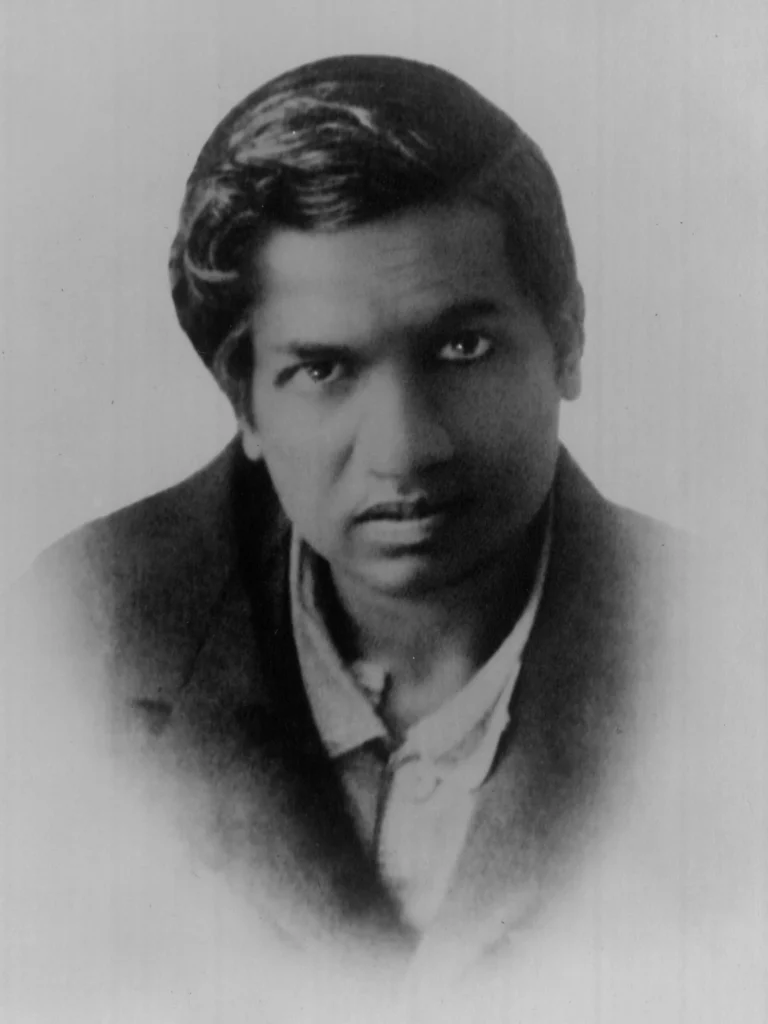
Srinivasa Ramanujan is a beacon of mathematical brilliance, whose contributions to number theory and formula development have altered the trajectory of modern mathematics. National Mathematics Day on December 22nd celebrates his genius, inspiring future generations to explore the realms of mathematics with curiosity and independence.
National Mathematics Day: Celebrating the Legacy of Srinivasa Ramanujan
National Mathematics Day is celebrated in India on 22 December to honor the birth anniversary of Srinivasa Ramanujan, one of the greatest mathematical minds the world has ever known. Observed nationwide, the day highlights the beauty, power, and relevance of mathematics in everyday life and modern science.
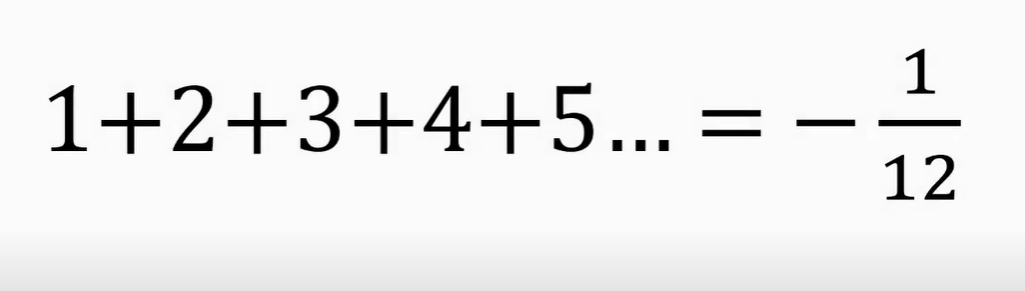
Ramanujan’s life is a remarkable story of genius, perseverance, and creativity. Despite limited formal training, his intuitive insights reshaped number theory, infinite series, and mathematical analysis. His work continues to influence fields ranging from cryptography to theoretical physics, reminding us that curiosity and passion can overcome any barrier.

National Mathematics Day also aims to inspire students and educators by promoting mathematical thinking, problem-solving skills, and innovation. Through lectures, workshops, and competitions, the day encourages young minds to see mathematics not as a subject of fear, but as a language of patterns that explains the universe.
Ultimately, National Mathematics Day celebrates not just equations and formulas, but the human spirit of discovery—embodied by Ramanujan—urging future generations to explore, question, and imagine through mathematics.
Ramanujan’s Early Life and Education
Srinivasa Ramanujan, a name that resonates powerfully within mathematical circles, emerged from humble beginnings in a small South Indian town named Erode. His early life, devoid of regal teachers, was marked by an extraordinary self-directed dive into mathematics that later formed the backbone of his groundbreaking contributions. Born on December 22, 1887, to a family of modest means, Ramanujan faced numerous challenges, but his sheer determination and passion for numbers allowed him to cultivate a unique and profound understanding of mathematics.

Ramanujan’s journey began in the bustling streets of Kumbakonam, a town rich in culture and history. Raised in a household that valued education, Ramanujan attended the local school, where he demonstrated remarkable talents in the mathematical arts at an early age. He received a scholarship to study at the Government Arts College in Kumbakonam. Unfortunately, family circumstances forced the family to move, leading Ramanujan to Town High School in Kumbakonam, where his flame for mathematics was reignited by the encounter with important works in the field.
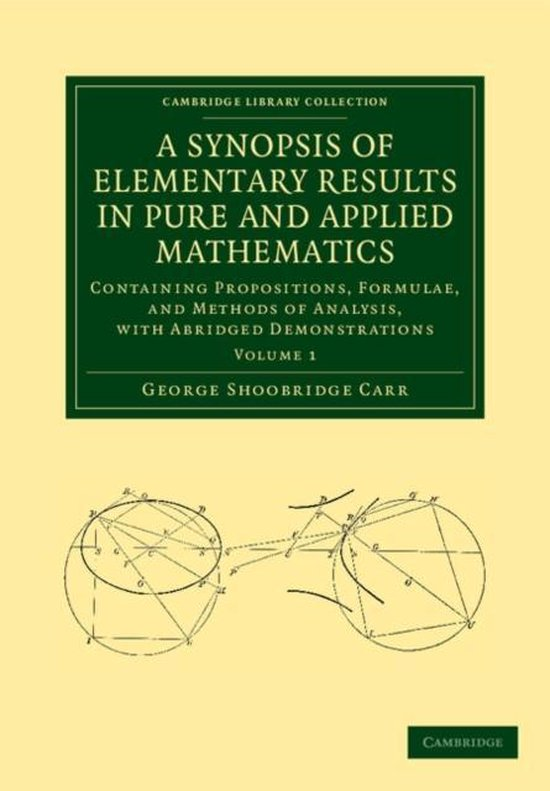
Arguably, the most pivotal moment in his early education was when he stumbled upon a copy of G. S. Carr’s “A Synopsis of Elementary Results in Pure and Applied Mathematics.” This compendium contained a treasure trove of formulas and theorems, devoid of explanations and proofs, which became a cornerstone of Ramanujan’s own educational endeavors. Lacking formal guidance, he ingeniously deduced many proofs by reverse engineering Carr’s statements, honing his skills in the process. This self-taught methodology not only fostered creativity but also led him to derive results that were original and sometimes unconventional.
Before Ramanujan could establish a robust mathematical career, he faced numerous trials. Despite his profound prowesses, he failed his college examinations due to his singular focus on mathematics. Such setbacks highlighted the disparity between his immense talent and the inadequacies of a traditional educational framework that did not cater to prodigious abilities. Perennially on the brink of financial ruin, Ramanujan’s journey was fraught with uncertainty and yet was fueled by an unwavering commitment to his passion.
His approach to mathematics was characterized by a deep spiritual reverence for numbers, a practice not entirely divorced from his cultural roots. Growing up in a society where spirituality and philosophy intertwined with daily life, Ramanujan viewed mathematics as a divine pursuit. He expressed that his mathematical findings were revelations from the goddess Namagiri, whom he revered deeply. This intermingling of spirituality with intellect fostered a perspective that divorced his calculations from the mechanistic drills of academia, enriching his insights and grounding his theories in an almost mystical understanding of the universe.
Much of Ramanujan’s early work was conducted independently in dire circumstances. His insistence on following his intellectual passions above all else often placed him in precarious financial situations. Nonetheless, his perseverance paid homage to his belief in the beauty and importance of his work. His lack of formal education in advanced mathematics meant that he often reinvented mathematical concepts independently. Although such independence occasionally veered him towards inaccuracies, it primarily paved new and innovative pathways in number theory that were unexplored.

Despite these struggles, Ramanujan never existed in complete isolation. He actively sought out peers and mentors who could appreciate and critique his ideas. He corresponded incessantly with mates who shared his love for numbers and occasionally wrote to renowned mathematicians, striving to validate and share his work. Eventually, his relentless efforts caught the attention of G. H. Hardy, a prominent English mathematician. Intrigued by the series of formidable theorems and results in an unsolicited letter from Ramanujan, Hardy invited him to Cambridge, an invitation that would pivotally alter the course of Ramanujan’s life.
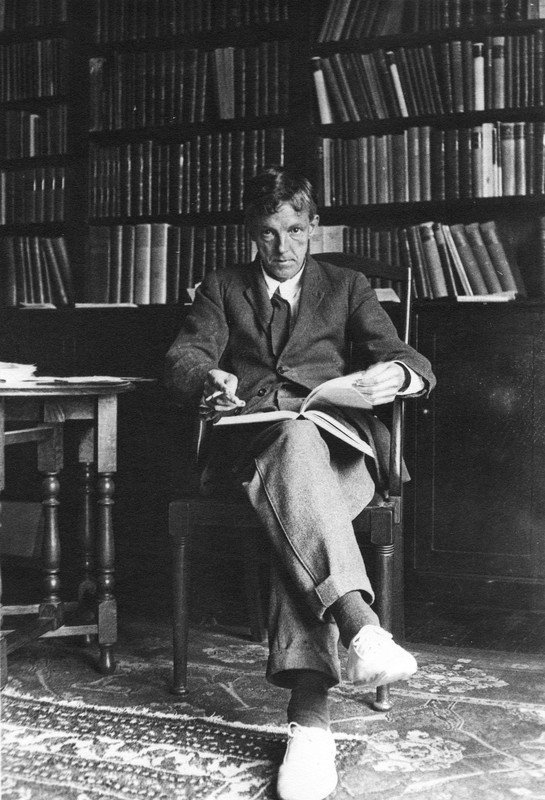
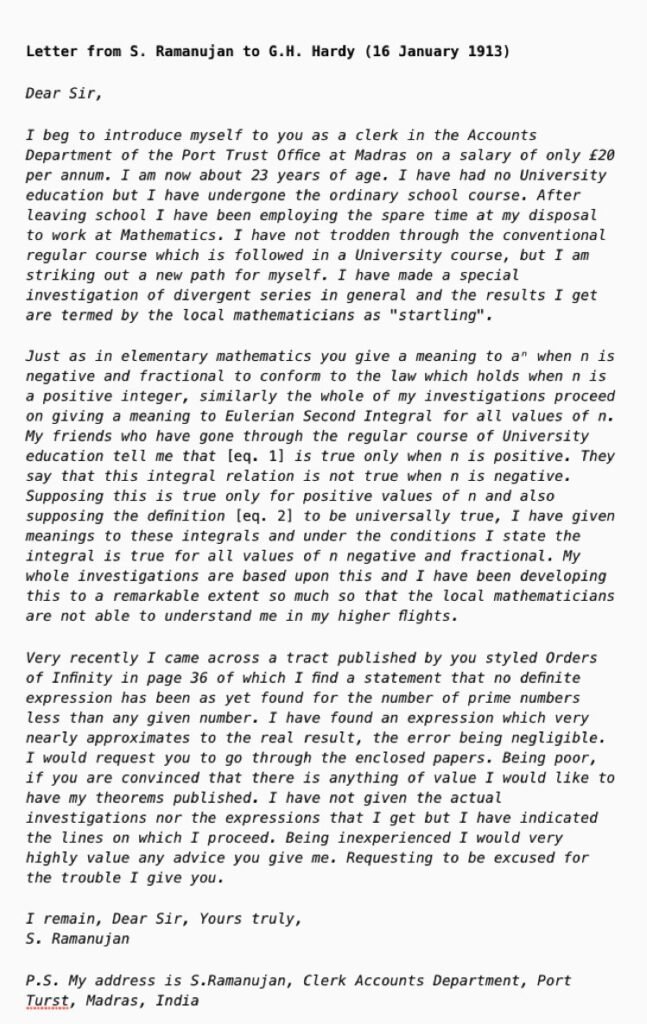
Hardy’s recognition of Ramanujan’s genius marked a transition from solitary passion to academic acknowledgment, proving that self-taught methodologies, though unconventional, could birth ideas cherished by the global mathematical community. Ramanujan’s unique approach, informed by his adversities and spiritual beliefs, complemented Hardy’s rigorous analytical skills, resulting in synergetic collaborations that further enveloped the world in the brilliance of his thoughts.
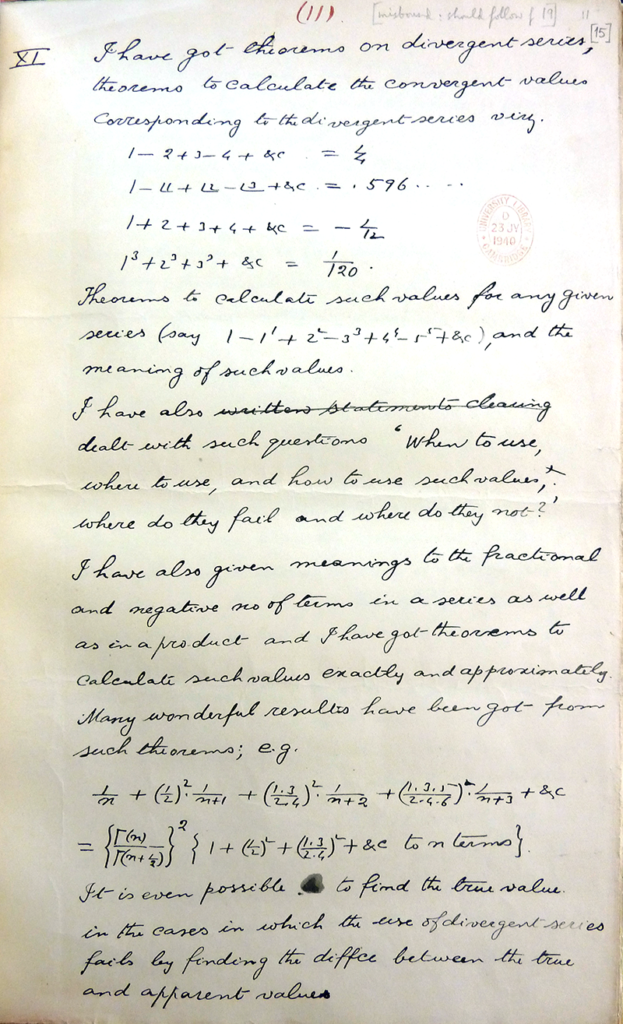
Ramanujan’s formative years underscore a narrative of resilience, creative independence, and a convergence of philosophical intuition with mathematical precision. This coupled development formed the bedrock for his later discoveries that continue to astonish and inspire contemporary mathematicians. His early life stands as a testament to the fact that genius knows neither boundary nor adversity but shines through in the darkest of places. Ramanujan not only conquered the academic frontier but also reshaped it to echo his visionary understanding of numbers, paving the way for the revolutionary discoveries in number theory discussed in the subsequent chapter.
By braving initial challenges with uniqueness, Ramanujan’s genius demonstrates how non-traditional learning environments can still herald outstanding intellectual triumphs. The correlation between his self-guided practices and later accomplishments emphasizes an alternative yet equally potent narrative to the wisdom imparted through structured academia, echoing the essence of how mathematics was learned rather than taught in Ramanujan’s storied journey.
Revolutionary Discoveries in Number Theory
Srinivasa Ramanujan’s contributions to number theory exemplify the intersection of intuition and rigor. His insights and discoveries defy conventional boundaries, deeply impacting modern mathematical study. Through his revolutionary work, Ramanujan explored number theory’s intricate landscape, offering new tools and perspectives.
Foremost among Ramanujan’s contributions is his work on partitions. In mathematics, a partition of a positive integer refers to a way of writing it as a sum of positive integers. Ramanujan’s collaboration with English mathematician G.H. Hardy led to a profound understanding of partition theory. They developed the Hardy-Ramanujan asymptotic formula, providing an accurate approximation for the partition function p(n), which counts the number of ways a number n can be expressed as a sum of integers. This formula remains a cornerstone in analytic number theory, offering insights into the intrinsic properties of integers.
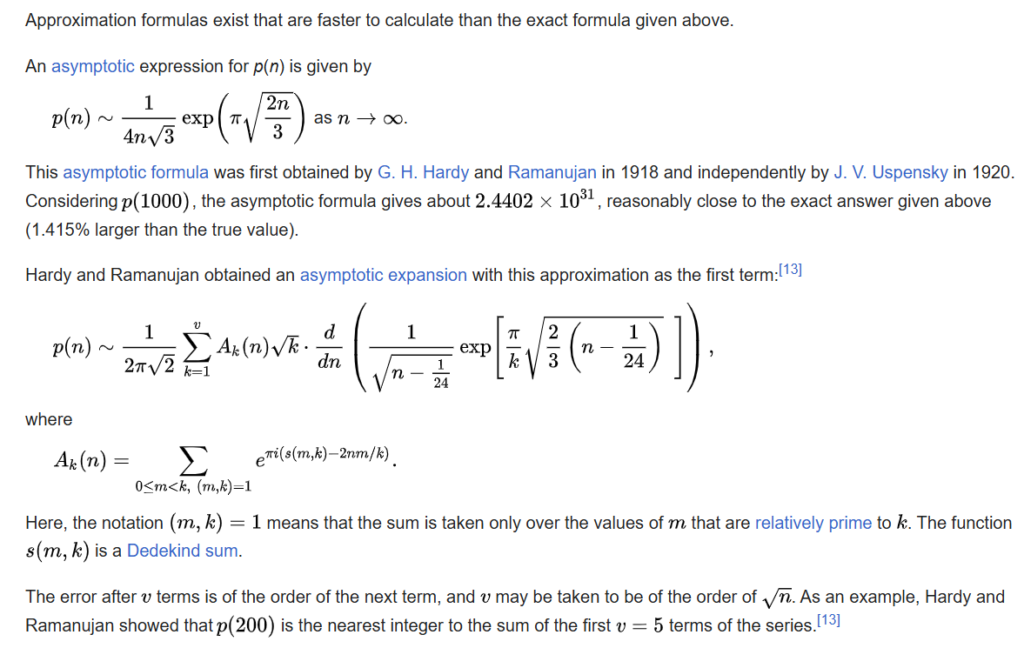
Ramanujan’s partition results go beyond mere formulas; they open avenues for rigorous exploration of the additive properties of numbers. To this day, mathematicians leverage these results, particularly in the study of q-series and modular forms, both areas deeply tied to partition theory. For example, the partition generating functions of numbers link directly to modular forms, and Ramanujan’s work laid foundational aspects of such interconnections. His discoveries act as a vital resource for research in algebraic geometry and representation theory.
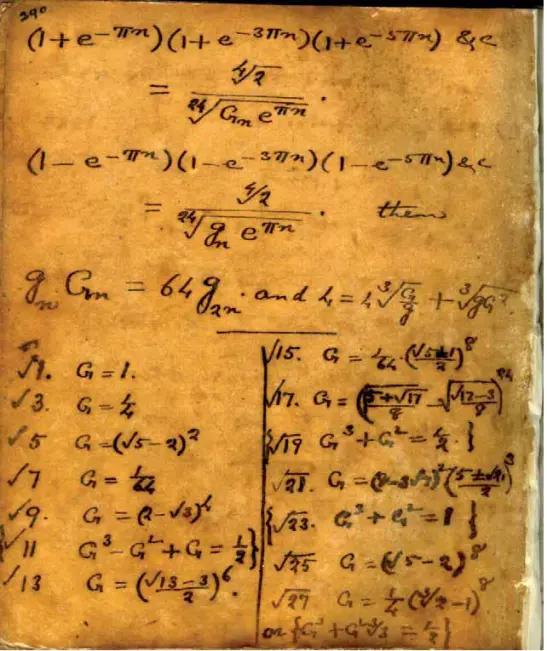
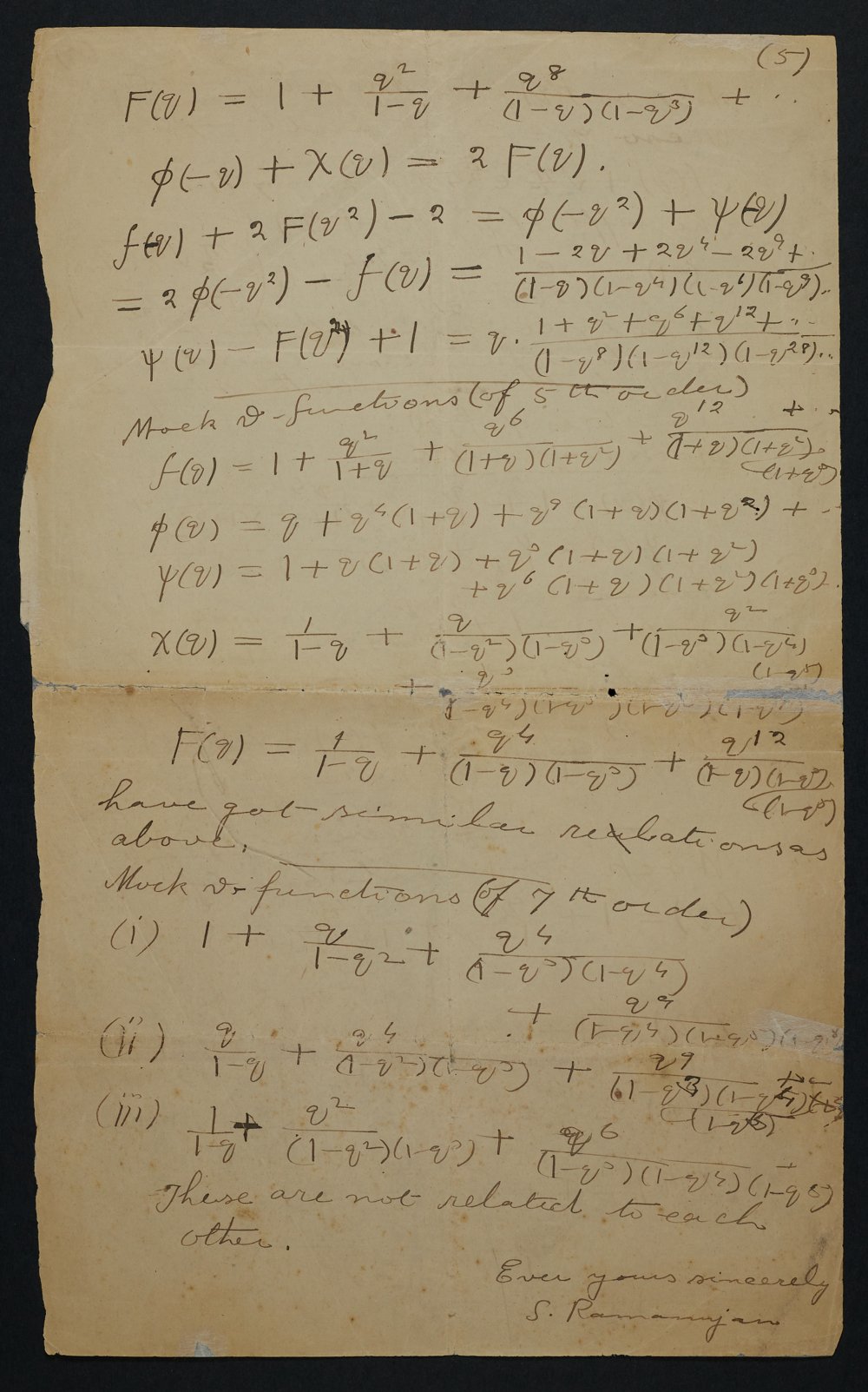
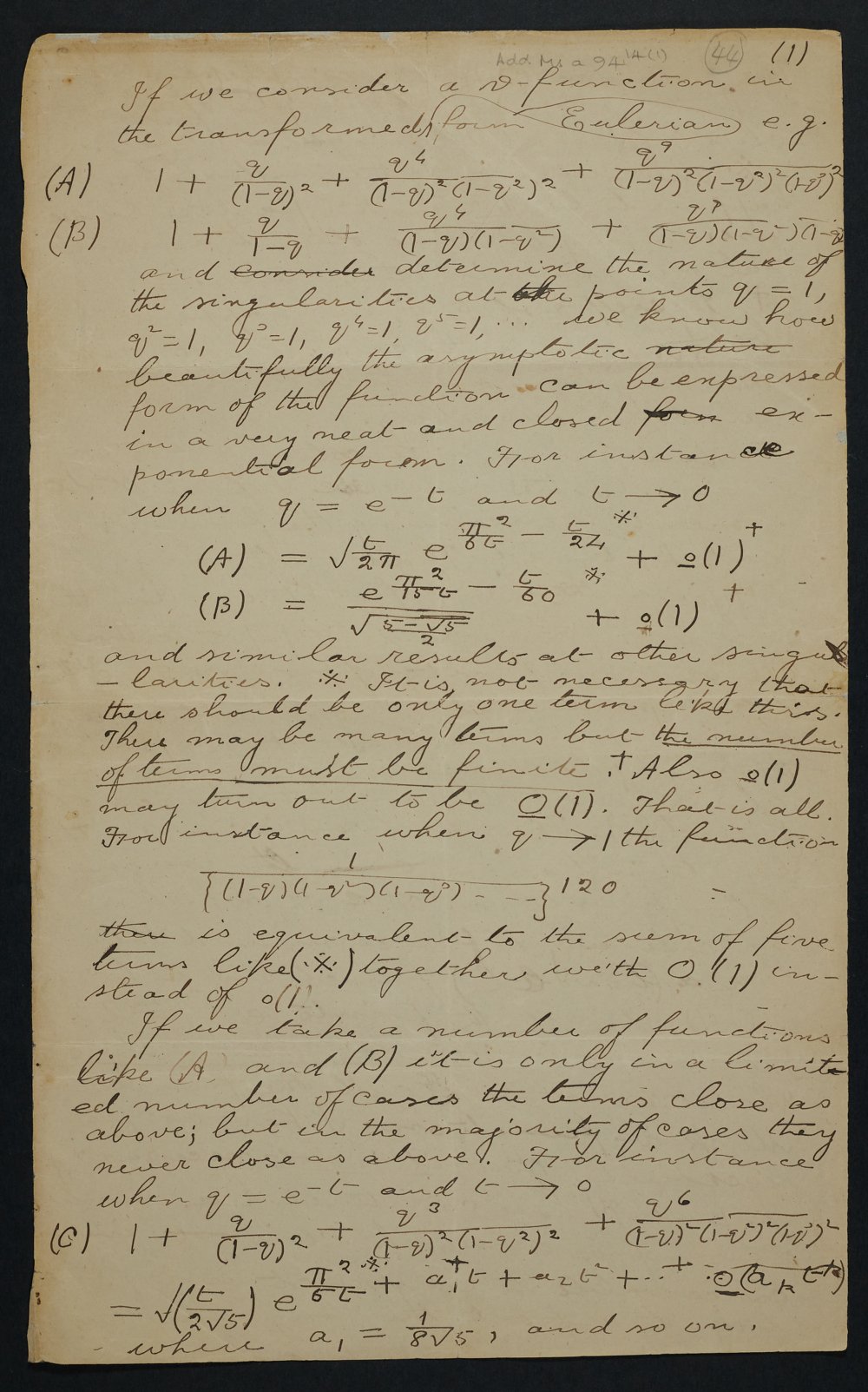
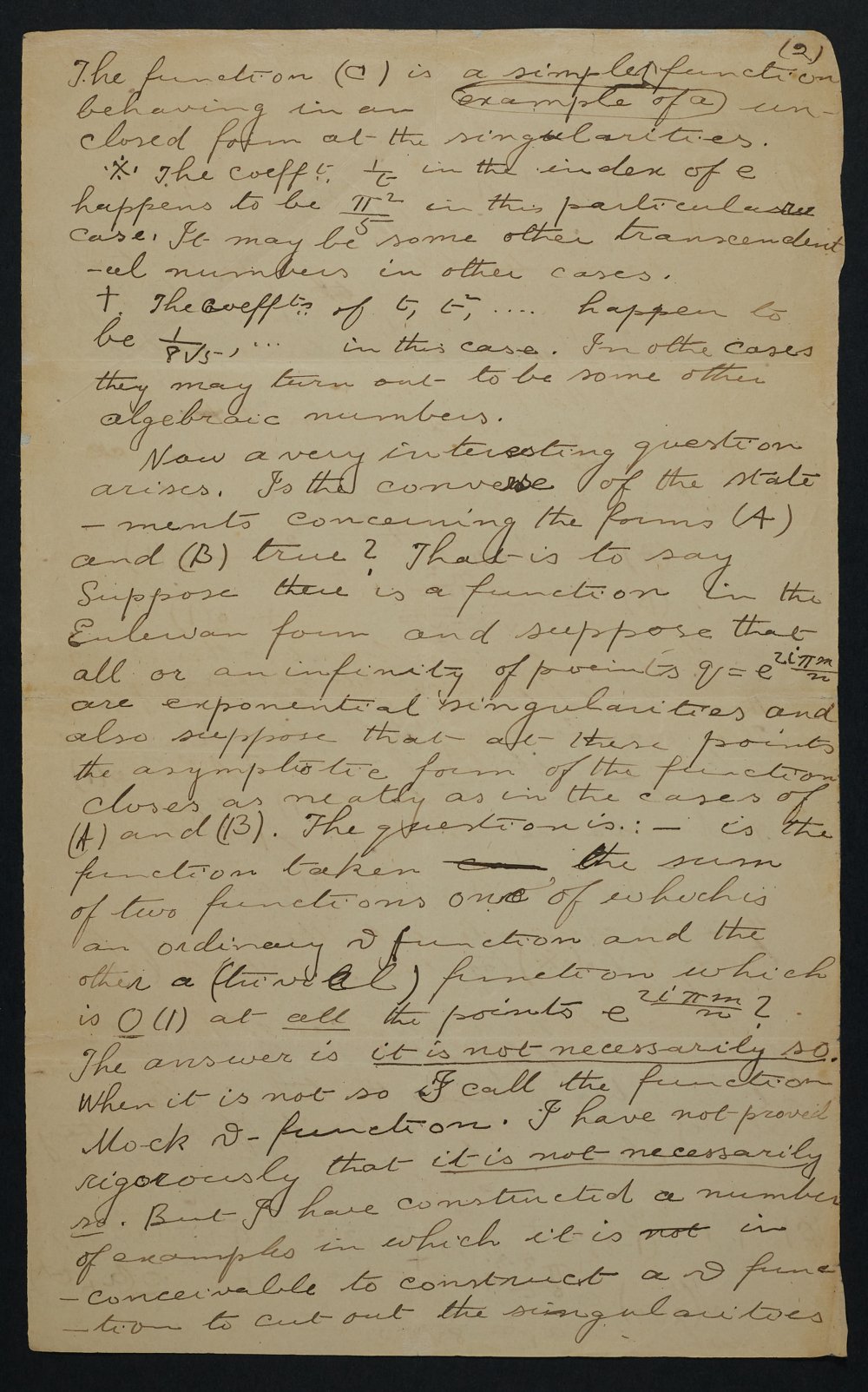
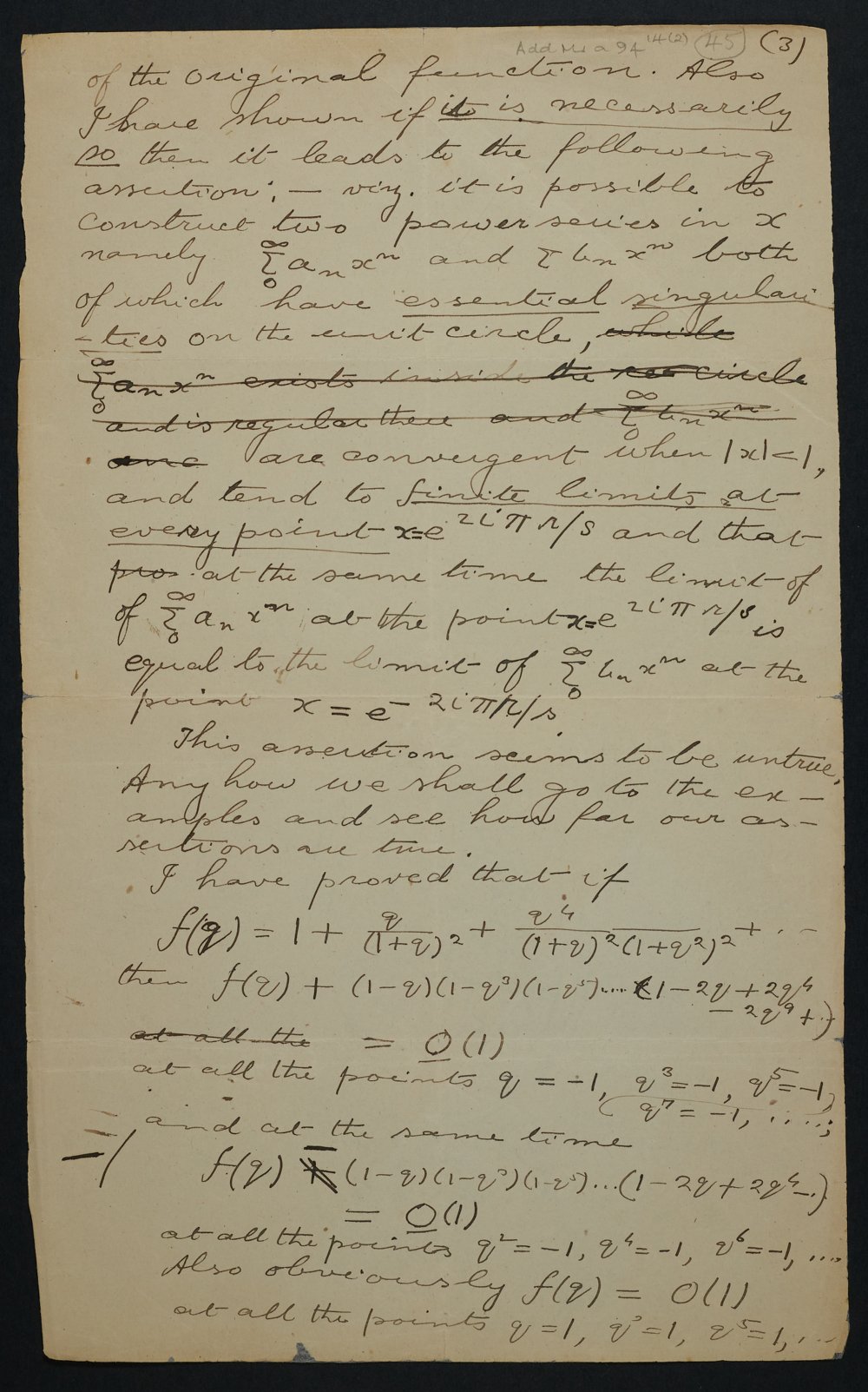
Another significant aspect of Ramanujan’s influence is the mock theta functions. Discovered during his self-taught exploration, these functions initially seemed isolated idiosyncrasies in the mathematical world. However, mock theta functions gained recognition and became pivotal to understanding the realm of q-hypergeometric series and modular forms. Ramanujan’s fascination with these expressions contributed groundwork for modular forms unified within the broader framework of quantum modular forms. In far-reaching applications today, mock theta functions provide tools for examining quantum symmetry and string theory, elevating abstraction to a new level of exploration.
Ramanujan’s Mock Theta function
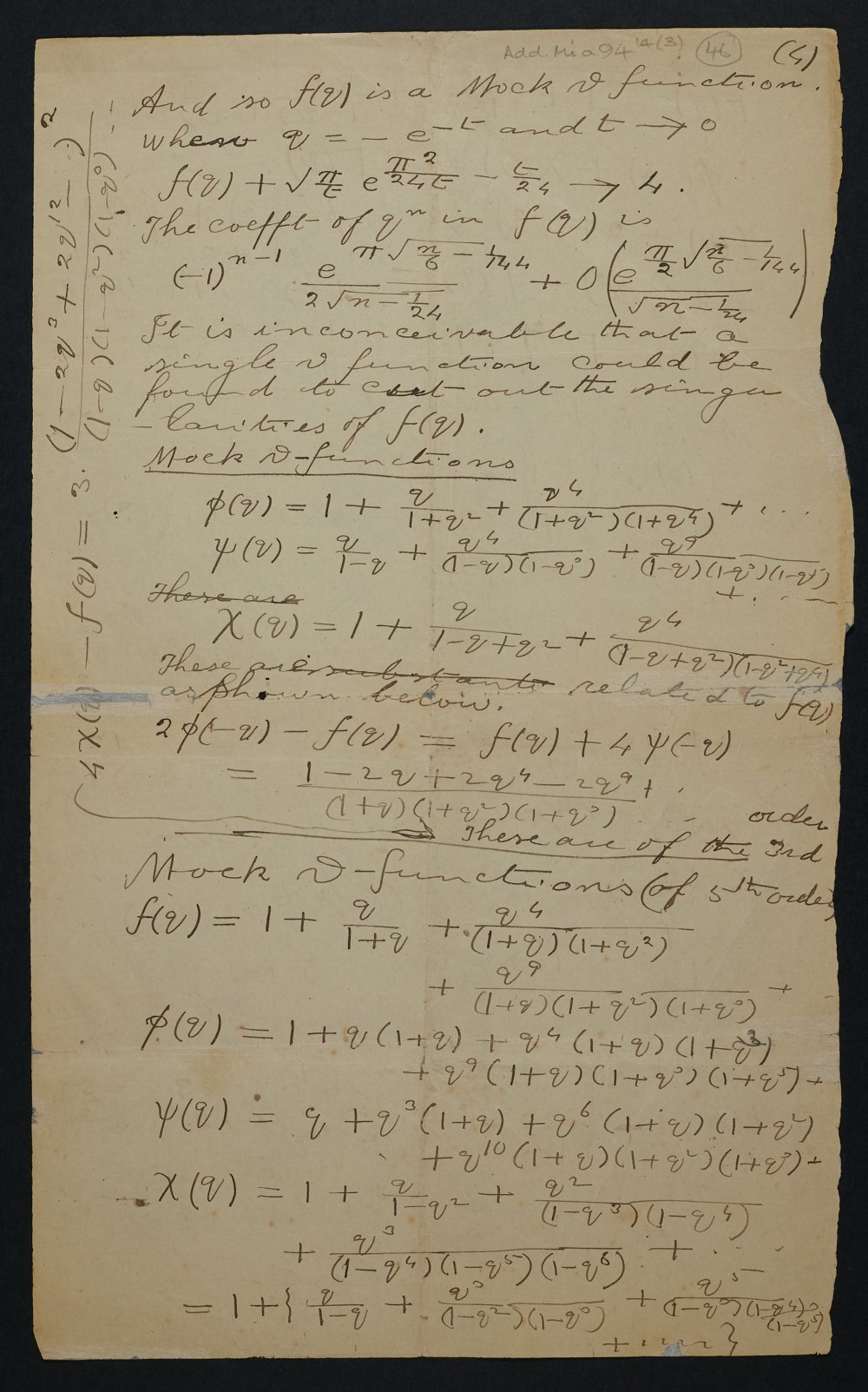
Furthermore, the Ramanujan congruences present a fascinating set of properties related to the partition function. Ramanujan observed specific congruences for partitions, such as the fact that p(5n+4) is divisible by 5. His insights into these congruences led to further explorations within modular arithmetic. Today, scholars continue building on Ramanujan’s observation by delving into partition congruences modulo prime numbers. This line of research has ramifications for studying the arithmetic properties of modular forms and holds keys to unlocking deeper arithmetic mysteries.
Ramanujan’s depth of understanding and intuitive calculation led to the Ramanujan prime numbers. His unique definition of these primes offers an alternative view into the regular distribution of prime numbers. Ramanujan primes have become crucial to heuristic arguments and proofs in prime number theory. They engage current researchers in examining prime distribution within defined limits, posing hypotheses about the intricacies of integer partitions and their underlying structures.
The remarkable influence of Ramanujan’s formulas extends to the fields of combinatorics and computer science. For instance, his addition of rapidly converging series for calculating π significantly impacts algorithms used for precision calculations. Ramanujan’s series expansions are employed in computer arithmetic, driving forward the limits of numerical procedures and computational accuracy.

Despite the passage of time, the essence of Ramanujan’s revolutionary work flows through today’s number theory, influencing diverse mathematical directions. His approach demonstrates the importance of combining creativity with analytical precision, a method echoing throughout academic pursuits. Ramanujan’s contributions encourage the blurring of lines between pure and applied mathematics, fostering an environment of innovation and discovery.
The insights gathered from Ramanujan’s legacy underscore the continued relevance of his discoveries. They illustrate how mathematical genius transcends eras, motivating ongoing scrutiny and reflection. Modern mathematicians, inspired by his methods and the results of his endeavors, continue unveiling the mathematical universe, driving fields of study to explore uncharted territories. Ramanujan’s influence endures as a testament to the power of curiosity and independent thinking, impacting the foundations of number theory, one partition, congruence, and formula at a time.
Legacy and Influence on Modern Mathematics
The legacy of Srinivasa Ramanujan extends far beyond his celebrated contributions to number theory. His influence permeates contemporary mathematics, both in academic circles and the broader public consciousness. The recognition of his genius shows in a resounding appreciation for his intuitive insights and unconventional methodologies. Today’s researchers continue to draw inspiration from his work, perpetuating his spirit of exploration and innovation.
Ramanujan’s influence on modern mathematics manifests in various dimensions. Some of his discoveries, notably in combinatorics and the fascinating realm of partitions, have yet to be wholly unlocked. These works serve as foundational frameworks for ongoing research. They offer both challenges and opportunities for today’s mathematicians. Exploring the rich terrains of Ramanujan’s equations, conjectures, and theorems has become a perpetual journey. It carries the allure of uncharted terrains awaiting discovery.
One cannot overstate the importance of independent thinking and curiosity in Ramanujan’s academic voyage. His journey serves as a poignant reminder of the power of a questioning mind. Ramanujan never conformed to conventional educational pathways. Instead, his insatiable curiosity propelled him across mathematical landscapes. His approach was marked by a bold disregard for established structures and a passionate plunge into the mysteries of numbers. This pursuit often led to discoveries that the world at first struggled to comprehend.
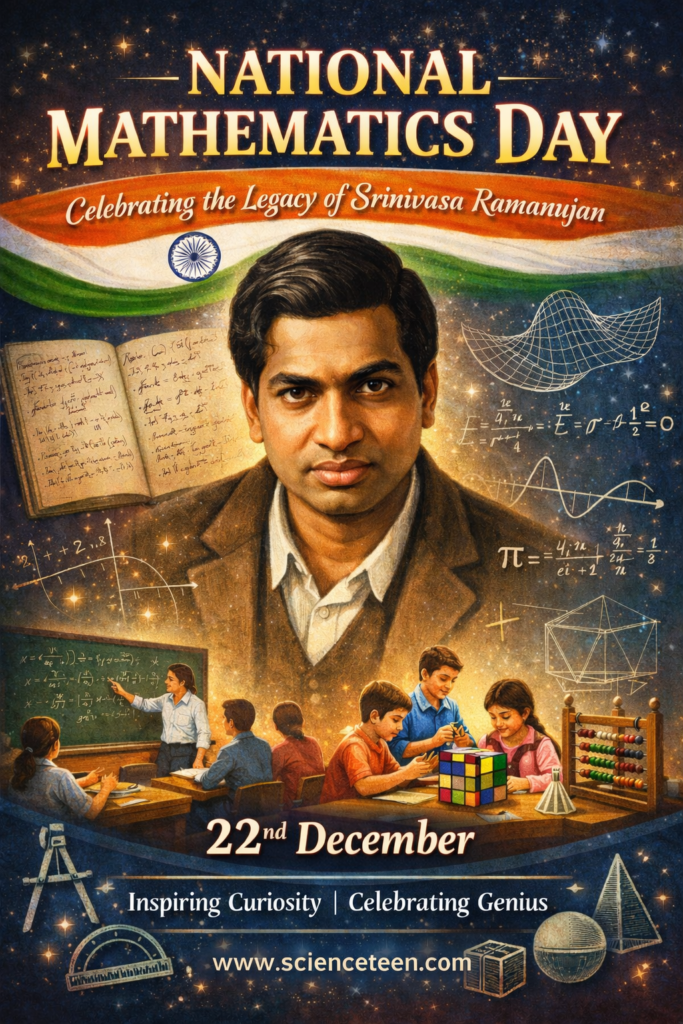
To understand the deep impact Ramanujan has left on modern mathematics, it is worthwhile to observe educational and public initiatives inspired by his journey. In India, National Mathematics Day is celebrated every 22nd of December in his honor. This annual event illuminates the role of mathematics in daily life. It fosters a culture of curiosity and interest among students. Daily mathematical applications resonate with the foundational spirit of Ramanujan’s work. His legacy pervades these celebrations, infusing them with a narrative of inspiration and discovery.
In academia, his manuscripts and notebooks continue to invite scrutiny and exploration. Ramanujan’s enigmatic mock theta functions have opened newer frontiers in string theory and quantum physics. It exemplifies his work’s timelessness—a testament to his perspicacious insights. These relationships harness the fundamental nature of mathematics: a bridge across diverse scientific fields.
Ramanujan’s style of thinking—defined by leaps rather than linear progressions—offers a distinct model for thinkers today. Encouraging independent thought and innovative problem-solving is vital in education. Ramanujan’s life underscores that mathematical genius is not contingent on formal education. Rather, it thrives on the passion and persistence of the intellect. His genuine fascination with the subtleties of numbers led him on a voyage well-admired and respected.
The impact of such creativity becomes more evident as we delve deeper into contemporary mathematics. Number theory, for instance, continues to benefit from Ramanujan’s insights. His work has imbued a breath of fresh air into other mathematical domains, such as algebraic geometry and topology. The search for deeper understanding and the thrill of discovery shows in further research inspired by his work.
Even broader fields such as computer science and cryptography find roots in Ramanujan’s discoveries. Many cryptographic algorithms rely on properties of prime numbers – an area where Ramanujan made significant advancements. His findings continue to assist in developing stronger encryption methodologies and improving digital security frameworks.

Ramanujan’s tale teaches the profound potency of belief in one’s potential. His correspondence with G.H. Hardy, grounded in both simplicity and earnestness, illustrates the sheer impact of brilliance allied with sheer determination. Ramanujan’s story is one of individuality incomparable to structured educational philosophies. It inspires us today to rethink how we approach education and nurture creativity among students. Current scholars frequently stress the importance of mathematical intuition over rote memorization, advocating for critical thinking and questioning as conducive to intellectual development.
For modern-day mathematicians, studying Ramanujan’s achievements offers a practical lesson in patience and perseverance. His efforts exemplify that revolutionary ideas often emerge through grace under adversity and a profound commitment to one’s passion. As readers and researchers, engaging with Ramanujan’s journey serves as a trove of knowledge. One gains not just insights into number theory but also an understanding of the essence of mathematical exploration.
The continued research into his work also opens doors of collaboration across varied domains. Today, interdisciplinary approaches reflect a comprehensive dialogue among mathematicians, physicists, and technologists. These dialogues owe much to Ramanujan’s pioneering illustrations, which intersect various areas of study, fostering rich exchanges. Here, the importance of curiosity—unfettered, relentless, and potent—remains undisputed.

To delve into Ramanujan’s work is an invitation to be earnest in our intellectual pursuits. It offers reminders of the infinite possibilities lying within numbers and equations. Through engaging with such legacy, we embrace the consciousness of a learner, committed to understanding the limitless boundaries of numbers. The tapestry of Ramanujan’s legacy is woven with threads of intuition, adventure, and an unyielding inquiry.
Thus, let us champion and embody the tenets of exploration and independent thought in our journeys. By walking in the paths that Ramanujan illuminated, by embracing his spirit, we find ourselves in communion with a past rich in mathematical heritage and a future bright with limitless potential. We honor his memory not just by acknowledging his work, but by allowing his approach to guide our own into new realms of inquiry and discovery. For those eager to explore the rich universe of mathematics as Ramanujan once did, the journey into his discoveries awaits—a journey where infinite insights beckon those who dare to dream with numbers.
Final words
Srinivasa Ramanujan’s brilliance in number theory has left an indelible mark on mathematics. His life and work epitomize the power of curiosity and independent learning. Ramanujan’s story encourages current and future generations to embrace mathematical inquiry. Explore his legacy further through the dedicated initiatives and celebrations inspired by his genius.